
2026 Official Selection
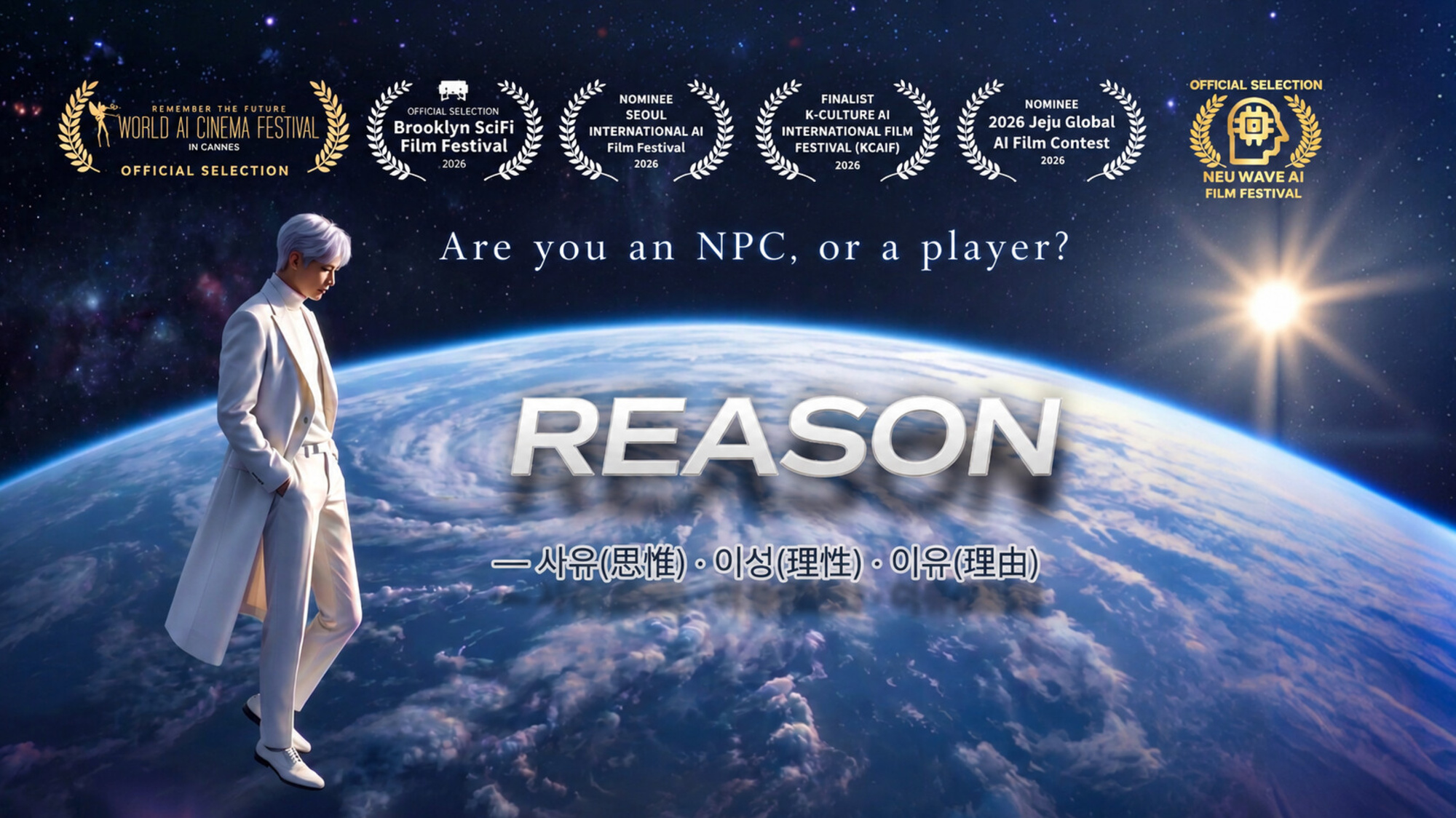
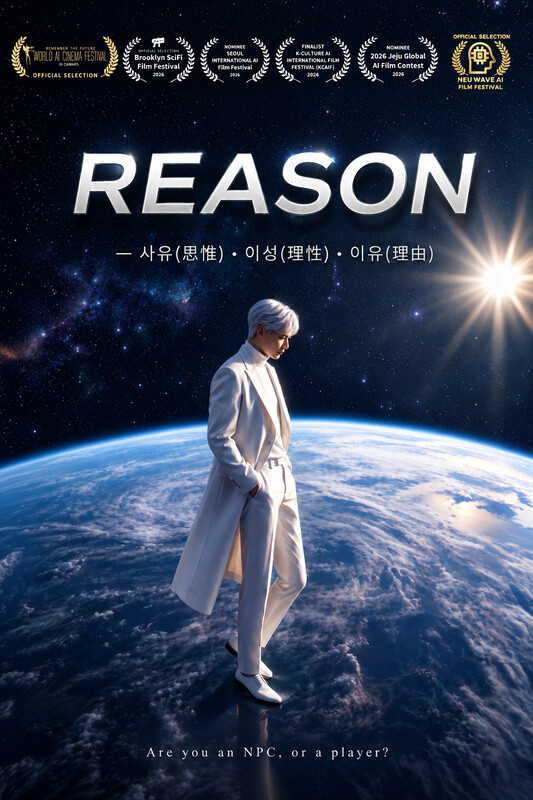
REASON
[REASON] Are you an NPC, uncritically accepting whatever the system gives you, trapped in confirmation bias? Or are you a Player, doubting and questioning to find the truth beyond what is shown? [Genre] Hard Sci-Fi / Philosophical Drama / K-Superhero — Built on Scientific and Logical Thinking [Logline] After his younger brother dies, Gang-ho seeks to bring him back through scientific inquiry and philosophical reasoning, awakening to the truth that the world is a simulation and ultimately choosing to save the world he has thrown into crisis. [Synopsis] After the failure of his VR arcade business,Gang-ho gets into an argument with his younger brother over drinks. That same night, his brother dies in a car accident. Consumed by guilt, Gang-ho gives up on life. One night, staring up at the stars and mourning his brother, Gang-ho has a sudden realization. If Earth, as seen from Alpha Centauri, appears as it did four years ago, then Earth as seen from Alpha Centauri would also be four years in the past. Could his brother still be alive there? Clinging to that sliver of hope, Gang-ho returns to the scientific studies he had long abandoned. Once a prodigy in a gifted-science program as a child,Gang-ho immerses himself in quantum mechanics and discovers something startling. Its principles bear an uncanny resemblance to how a video game operates. He begins to suspect that reality itself might be a vast simulation. Since childhood, Gang-ho had never stopped asking "why." But he was raised to memorize given answers, and eventually he stopped asking. His brother's death reawakens the instinct to question that he had suppressed for so long. Meanwhile, Gang-ho begins experiencing inexplicable phenomena at the boundary between dream and reality, and through scientific and philosophical inquiry, he starts to wonder whether modern science and modern society confine human thought to only what can be observed. This doubt deepens his philosophical thinking, until at last he arrives at the conviction that this world is a simulation, and awakens to the truth. Once awakened, Gang-ho edits the code to alter his own appearance and acquires the dream car he always wanted. Recalling the theory of relativity, he attempts to exceed the speed of light in order to bring his brother back to life. And in the moment his relative timeline synchronizes with reality, the true structure of this world, one he never knew, is revealed. In the near future, humanity develops a revolutionary game built on quantum-portal connection technology and real-time AI rendering. Within it, people can live nearly infinite lives and make nearly infinite choices. But because time inside the simulation flows overwhelmingly faster than in reality, memories from before entering the game are not retained. Within this simulated game, humans exist either as actual human players or as NPCs. The system of this world is designed so that people cannot form the question "why," because that question would eventually reveal that this world is a simulation. But Gang-ho's attempt to break the speed of light, in his effort to bring his brother back, triggers a critical bug in the simulation. The world's "why-suppression" function malfunctions, and instead of suppressing the question, the system itself begins asking "why" to players and NPCs alike. This is the "WHY Bug." Players begin to awaken one by one, while NPCs, caught in the conflict between their logic code and emotion code, mutate into monsters. But Gang-ho's breach of light speed causes a problem even more severe than the WHY Bug. As the relative flow of time between the simulation and reality synchronizes for Gang-ho, he recovers the memories he had lost. For everyone else, however, the relative time gap only widens further, and their connection to the server is severed. Players who lose their server connection now die for real in reality when they die inside the simulation. Meanwhile, as Gang-ho flies at the speed of light, the effects of relativity carry him to a slightly more distant future, one devastated by the monsters. There, he confronts the truth: the choice he made to save his brother has plunged countless people into a crisis of real death. He now faces the ultimate choice. Should he log out, atoning for the guilt of losing his brother in the past, and finally being reunited with him? Or should he remain in this world, for the sake of the people whose real deaths are now at stake because of him? Gang-ho is about to make his final choice. [Director's Statement] 1. A Korean Hard Sci-Fi for an Age That Has Stopped Asking Questions REASON is not simply a film about simulation cosmology. The most fundamental question this work poses is: do we truly think and choose for ourselves? We live in an age that consumes more information than at any point in history. Yet, paradoxically, rather than thinking and questioning for ourselves, we have grown accustomed to consuming answers that are already given to us, becoming dependent on algorithms and trapped in confirmation bias. Furthermore, modern society tends to accept only what is visible and observable as the whole of fact, judging without fully considering the causes and possibilities that may lie beneath the surface. This is a problem that must continually be questioned, not only in social judgment, but in scientific inquiry as well. We need to ask again: is what we observe truly all there is to reality? Can we rule out the possibility of something's existence simply because it hasn't been observed? And is the very standard of judgment we take for granted actually valid? REASON explores these facets of contemporary society through the genre of hard science fiction. Rather than treating science fiction as a mere backdrop for emotional drama, the film places scientific hypotheses, philosophical reasoning, and questions from modern physics and neuroscience at the center of its narrative. By making unresolved scientific mysteries the driving force of the story, the film seeks to raise new questions about the nature of reality and human free will, exploring new possibilities for Korean hard sci-fi cinema. 2. The Continuity of Memory Creates the Illusion of Reality This film begins with the question: what is our basis for believing something is real? Conventional simulation theory holds that graphics and sensations so refined they are indistinguishable from reality are what create the feeling of realness. REASON, however, proposes a more fundamental new hypothesis. The reason we believe something is real is not determined by how sophisticated that world is, but by whether memories from before that world existed for us. No matter how perfect a virtual reality game may be, we never mistake it for reality, because we retain memories from before we entered it. In a dream, by contrast, even the most absurd violations of physical law feel natural and real to us, because our memory is severed from the moment just before we fell asleep. In other words, even if the world we live in were as simple as an 8-bit video game, a human being with no memory of anything prior would simply believe that world to be reality as it has always been. The film proposes a new philosophical hypothesis: what makes something feel real to us is not the completeness of the world, but the continuity of memory. 3. Relative Time Erases Memory In dreams, we feel as though far more time has passed than it actually has. Yet when we wake, we find that only a few minutes have passed in reality. The film applies this phenomenon to its simulation hypothesis. The quantum teleportation based virtual reality within the simulation is designed so that time flows far faster than it does in the real world. As a result, in just a few hours of real time, one can live and experience decades of life within the game. But it is precisely this overwhelming difference in the flow of time that has a decisive effect on human memory. As time within the game flows far faster than in reality, memories of reality cannot keep pace. Just as we come to accept the dream world as reality while we are dreaming, the consciousness of a person connected to the simulation likewise comes to accept the world within the game as their own reality. As a result, the player loses their memory of the reality that existed before their connection, and, without even recognizing that they exist within a simulation, comes to live believing that world to be actual reality. The film presents this loss of memory not as an arbitrary plot device, but as an original hypothesis: a natural phenomenon arising from the relative difference in the flow of time between two different timelines, which in turn affects human memory and one's perception of reality. 4. The Speed of Light and Lost Memory Gang-ho, the protagonist, searches for a way to turn back time in order to bring his dead brother back to life, and in the process gradually approaches the speed of light. According to the theory of relativity, his sense of time slows, and eventually the time within the game and the time of reality begin to resynchronize. At that moment, his memories from before he connected to the simulation return, and he realizes this world was merely a world inside a game. Conversely, everyone except Gang-ho is thrown into an even greater relative time gap, and their connection to the server is eventually severed, meaning that when they die within the game, they can no longer be automatically logged out, and instead face real death. This design is the film's core device, connecting the theory of relativity, memory, and its simulation worldview into a single unified logic. 5. From Quantum Possibility to Human Free Will This film reinterprets the difficult concepts of quantum mechanics through the familiar logic of game engine optimization and AI rendering. The concept of "real-time AI rendering simulation," where areas the player is not looking at remain unprocessed until observed, at which point the AI generates the world in real time, serves as an original cinematic device to express quantum superposition and the observer effect. Through this, the film visually expresses the idea that observation creates reality, while also proposing the possibility that the world is not a fixed structure completed in advance, but a space completed through human choice and free will. The film extends this concept, that multiple possibilities remain open until a choice determines a single outcome, into the physical experience of half-engaging a manual clutch. Before the clutch is fully released, power is neither fully transmitted nor fully cut off; a state exists between connection and disconnection. The director uses this as a metaphor for free will, the moment when, amid multiple open possibilities, a human being chooses one outcome and makes it real. Accordingly, the scene of manually shifting gears in the Corvette is not simply meant to showcase the protagonist's dream car. The tactile experience of operating a manual transmission by hand, felt directly through touch, becomes, in itself, a physical symbol of free will. Ultimately, the half-clutch represents possibility before it is determined, the gear shift represents human choice, and the movement of the car represents the process by which choice transforms into reality. Through this, the film extends the concept of possibility, which originates in quantum mechanics, into a philosophical question about human choice and free will. 6. Naturally Occurring, or Designed? The film poses a question humanity has long pondered. Did the universe we live in arise naturally, or was it designed by someone? The multiverse theory represents the leading hypothesis for natural occurrence; simulation cosmology represents the leading hypothesis for a designed world. Conventional simulation hypotheses view even humans as nothing more than code within a vast program. REASON goes a step further. The film proposes a new possibility: that humans are not mere code, but players endowed with free will, beings capable of recognizing the system and choosing for themselves. 7. NPCs and Monsters: A Reflection of a Society That Has Stopped Thinking The NPCs and the monsters they mutate into are not simply physical enemies. They are a metaphor for a modern society that has stopped thinking for itself. A person who, without independent thought, consumes only the information provided by an algorithm and falls into confirmation bias is, at its core, no different from an NPC within the system. As emotion and instant reaction overwhelm reason and reflection, people come to follow the answers the system provides rather than making judgments of their own. In such a society, only visible results and observed phenomena are easily taken to be the whole of reality. But the fact that something has not been observed does not mean it does not exist, and what appears on the surface may itself be the result of deeper causes and structural backgrounds. This is precisely the question REASON seeks to raise. The film is not intended to criticize or defend any particular political position or group. Whether in social judgment or scientific inquiry, it questions the very attitude of drawing conclusions based solely on given premises and surface level results. The film's depiction of the strong and the weak follows the same principle. Rather than defining any particular group as absolutely weak or absolutely strong, the film seeks to examine, from multiple angles, the historical conditions and circumstances that produced such evaluations, and how the benefits granted to one side affect others. The apocalypse depicted in the film symbolizes a contemporary society in which the paralysis of independent thought has reached its extreme. When people stop questioning for themselves and passively accept the system's answers, they cease to be individuals choosing with their own will and become nothing more than NPCs following their given programming. Taking this further, the transformation of NPCs into monsters is a metaphor of its own. When people trapped in confirmation bias, having stopped thinking for themselves, attack others, that behavior is ultimately no different from the monsters themselves. But REASON does not stop at social critique. It presents the very act of questioning as a philosophical solution in itself. To doubt what we have long taken for granted, to reexamine the premises behind the answers we are given, and to refuse to rule out possibilities simply because they are unseen or unobserved. This is the starting point for reclaiming independent thought and free will. Ultimately, the message REASON seeks to convey is clear. Think for yourself. Ask questions. Look beyond what is visible, and through your own independent choice, meet the true reality. 8. A Deliberate Narrative Approach and a Hero Grounded in Reason In typical sci-fi superhero films, the protagonist is often granted extraordinary powers abruptly, within a science fiction setting, without sufficient logical explanation for why such powers are possible. REASON, however, grounds even the process by which Gang-ho gains his abilities in logical reasoning, built upon the scientific hypothesis of simulation cosmology. Gang-ho is not a chosen one. He becomes able to manipulate the rules of the world he exists in because he comes to understand how that world actually operates. In other words, his abilities are not an unexplainable superpower, but a natural consequence of understanding the structure of reality itself. At the same time, while REASON uses the metaphor of games and rendering to convey its scientific and philosophical hypotheses to a general audience, the director recognized that this connection could still feel difficult to grasp, and that failing to understand it could make the story's causal logic hard to follow. For this reason, the director deliberately chose not to rely solely on audience inference, cinematic imagery, abstraction, or indirect suggestion to convey the link between Gang-ho's realizations and their consequences, but instead to directly convey his thought process and discoveries through his monologue and dialogue. Ultimately, rather than granting extraordinary powers as a kind of miracle, REASON is designed so that abilities emerge as a result of understanding the fundamental structure of the world, and it attempts a new sci-fi hero narrative that conveys that logical process directly to the audience. 9. A New Grammar for AI Cinema That Dissolves the Boundaries of Reality REASON is not a film that uses AI merely as a production tool. It is a work that brings the very way AI generates worlds into the film's own worldview, using it as a core narrative principle. By combining the director's long personal reflection and real-life experience with modern physics, philosophy, and AI technology, the film dissolves the boundaries between dream and reality, between cinema and simulation, and poses a single question to the audience: "Are you a player who thinks for themselves, or an NPC output by the system?" This film is a philosophical hard sci-fi work that goes beyond mere entertainment, inviting the audience to reconsider the nature of consciousness, free will, and reality itself. [AI Production Notes] 1. A Hybrid Production Process and the Optimal Combination of AI Tools REASON was created based on an idea the director, currently a working automotive evaluator, had held for a long time, with approximately 99% of the entire production process realized through AI. Each AI model was deployed according to its distinct strengths: - Kling AI (80%): character emotional performance and dialogue scenes - Seedance (15%): dynamic action sequences - Google Veo (5%): documentary style texture and realism The music was also created using Suno AI, completing the work's philosophical and emotional atmosphere. 2. The 1% of Reality: The Philosophy of the Manual Transmission The only live-action footage used in the film is the scene of manually shifting gears in the Corvette, along with its real exhaust sound. The director believed that the tactile sensation of the clutch engaging, that fleeting instant between connection and disconnection, could only be conveyed through genuine human experience. This 1% of reality is deliberately contrasted with the 99% digital world, symbolizing the free will that the protagonist Gang-ho pursues. 3. Visualizing the Simulation Through AI's Imperfections This work does not hide the limitations of current AI technology. Instead, it actively incorporates them into the story and its visual language. - Text-generation errors: the phenomenon of AI failing to render text perfectly is connected to the cognitive difficulty of reading text within dreams, hinting at the artificiality of reality itself. - Visual distortion and frame instability: the uncanny textures, glitches, and frame breaks characteristic of AI are reinterpreted as quantum instability and simulation lag, allowing the audience to visually experience the fractures within the world. 4. Direct Creation Through Korean-Language Prompts Every prompt used for video and music generation was written directly in Korean by the director. This choice was made to minimize the loss of meaning that can occur through translation, and to convey the nuances of Korean sentiment and emotion to the AI as directly as possible. The director believes that the most direct language creates the deepest emotional resonance. Director: Choi Gang-ho
[REASON]
Are you an NPC, uncritically accepting whatever the system gives you, trapped in confirmation bias?
Or are you a Player, doubting and questioning to find the truth beyond what is shown?
[Genre]
Hard Sci-Fi / Philosophical Drama / K-Superhero — Built on Scientific and Logical Thinking
[Logline]
After his younger brother dies, Gang-ho seeks to bring him back through scientific inquiry and philosophical reasoning, awakening to the truth that the world is a simulation and ultimately choosing to save the world he has thrown into crisis.
[Synopsis]
After the failure of his VR arcade business,Gang-ho gets into an argument with his younger brother over drinks. That same night, his brother dies in a car accident. Consumed by guilt, Gang-ho gives up on life.
One night, staring up at the stars and mourning his brother, Gang-ho has a sudden realization. If Earth, as seen from Alpha Centauri, appears as it did four years ago, then Earth as seen from Alpha Centauri would also be four years in the past. Could his brother still be alive there? Clinging to that sliver of hope, Gang-ho returns to the scientific studies he had long abandoned.
Once a prodigy in a gifted-science program as a child,Gang-ho immerses himself in quantum mechanics and discovers something startling. Its principles bear an uncanny resemblance to how a video game operates. He begins to suspect that reality itself might be a vast simulation. Since childhood, Gang-ho had never stopped asking "why." But he was raised to memorize given answers, and eventually he stopped asking. His brother's death reawakens the instinct to question that he had suppressed for so long.
Meanwhile, Gang-ho begins experiencing inexplicable phenomena at the boundary between dream and reality, and through scientific and philosophical inquiry, he starts to wonder whether modern science and modern society confine human thought to only what can be observed. This doubt deepens his philosophical thinking, until at last he arrives at the conviction that this world is a simulation, and awakens to the truth.
Once awakened, Gang-ho edits the code to alter his own appearance and acquires the dream car he always wanted. Recalling the theory of relativity, he attempts to exceed the speed of light in order to bring his brother back to life. And in the moment his relative timeline synchronizes with reality, the true structure of this world, one he never knew, is revealed.
In the near future, humanity develops a revolutionary game built on quantum-portal connection technology and real-time AI rendering. Within it, people can live nearly infinite lives and make nearly infinite choices. But because time inside the simulation flows overwhelmingly faster than in reality, memories from before entering the game are not retained.
Within this simulated game, humans exist either as actual human players or as NPCs. The system of this world is designed so that people cannot form the question "why," because that question would eventually reveal that this world is a simulation.
But Gang-ho's attempt to break the speed of light, in his effort to bring his brother back, triggers a critical bug in the simulation. The world's "why-suppression" function malfunctions, and instead of suppressing the question, the system itself begins asking "why" to players and NPCs alike. This is the "WHY Bug." Players begin to awaken one by one, while NPCs, caught in the conflict between their logic code and emotion code, mutate into monsters.
But Gang-ho's breach of light speed causes a problem even more severe than the WHY Bug. As the relative flow of time between the simulation and reality synchronizes for Gang-ho, he recovers the memories he had lost. For everyone else, however, the relative time gap only widens further, and their connection to the server is severed. Players who lose their server connection now die for real in reality when they die inside the simulation.
Meanwhile, as Gang-ho flies at the speed of light, the effects of relativity carry him to a slightly more distant future, one devastated by the monsters. There, he confronts the truth: the choice he made to save his brother has plunged countless people into a crisis of real death. He now faces the ultimate choice.
Should he log out, atoning for the guilt of losing his brother in the past, and finally being reunited with him?
Or should he remain in this world, for the sake of the people whose real deaths are now at stake because of him?
Gang-ho is about to make his final choice.
[Director's Statement]
1. A Korean Hard Sci-Fi for an Age That Has Stopped Asking Questions
REASON is not simply a film about simulation cosmology.
The most fundamental question this work poses is: do we truly think and choose for ourselves?
We live in an age that consumes more information than at any point in history. Yet, paradoxically, rather than thinking and questioning for ourselves, we have grown accustomed to consuming answers that are already given to us, becoming dependent on algorithms and trapped in confirmation bias.
Furthermore, modern society tends to accept only what is visible and observable as the whole of fact, judging without fully considering the causes and possibilities that may lie beneath the surface. This is a problem that must continually be questioned, not only in social judgment, but in scientific inquiry as well.
We need to ask again: is what we observe truly all there is to reality? Can we rule out the possibility of something's existence simply because it hasn't been observed? And is the very standard of judgment we take for granted actually valid?
REASON explores these facets of contemporary society through the genre of hard science fiction.
Rather than treating science fiction as a mere backdrop for emotional drama, the film places scientific hypotheses, philosophical reasoning, and questions from modern physics and neuroscience at the center of its narrative.
By making unresolved scientific mysteries the driving force of the story, the film seeks to raise new questions about the nature of reality and human free will, exploring new possibilities for Korean hard sci-fi cinema.
2. The Continuity of Memory Creates the Illusion of Reality
This film begins with the question: what is our basis for believing something is real?
Conventional simulation theory holds that graphics and sensations so refined they are indistinguishable from reality are what create the feeling of realness. REASON, however, proposes a more fundamental new hypothesis.
The reason we believe something is real is not determined by how sophisticated that world is, but by whether memories from before that world existed for us.
No matter how perfect a virtual reality game may be, we never mistake it for reality, because we retain memories from before we entered it. In a dream, by contrast, even the most absurd violations of physical law feel natural and real to us, because our memory is severed from the moment just before we fell asleep.
In other words, even if the world we live in were as simple as an 8-bit video game, a human being with no memory of anything prior would simply believe that world to be reality as it has always been. The film proposes a new philosophical hypothesis: what makes something feel real to us is not the completeness of the world, but the continuity of memory.
3. Relative Time Erases Memory
In dreams, we feel as though far more time has passed than it actually has. Yet when we wake, we find that only a few minutes have passed in reality.
The film applies this phenomenon to its simulation hypothesis. The quantum teleportation based virtual reality within the simulation is designed so that time flows far faster than it does in the real world. As a result, in just a few hours of real time, one can live and experience decades of life within the game.
But it is precisely this overwhelming difference in the flow of time that has a decisive effect on human memory.
As time within the game flows far faster than in reality, memories of reality cannot keep pace. Just as we come to accept the dream world as reality while we are dreaming, the consciousness of a person connected to the simulation likewise comes to accept the world within the game as their own reality.
As a result, the player loses their memory of the reality that existed before their connection, and, without even recognizing that they exist within a simulation, comes to live believing that world to be actual reality.
The film presents this loss of memory not as an arbitrary plot device, but as an original hypothesis: a natural phenomenon arising from the relative difference in the flow of time between two different timelines, which in turn affects human memory and one's perception of reality.
4. The Speed of Light and Lost Memory
Gang-ho, the protagonist, searches for a way to turn back time in order to bring his dead brother back to life, and in the process gradually approaches the speed of light.
According to the theory of relativity, his sense of time slows, and eventually the time within the game and the time of reality begin to resynchronize. At that moment, his memories from before he connected to the simulation return, and he realizes this world was merely a world inside a game.
Conversely, everyone except Gang-ho is thrown into an even greater relative time gap, and their connection to the server is eventually severed, meaning that when they die within the game, they can no longer be automatically logged out, and instead face real death.
This design is the film's core device, connecting the theory of relativity, memory, and its simulation worldview into a single unified logic.
5. From Quantum Possibility to Human Free Will
This film reinterprets the difficult concepts of quantum mechanics through the familiar logic of game engine optimization and AI rendering.
The concept of "real-time AI rendering simulation," where areas the player is not looking at remain unprocessed until observed, at which point the AI generates the world in real time, serves as an original cinematic device to express quantum superposition and the observer effect.
Through this, the film visually expresses the idea that observation creates reality, while also proposing the possibility that the world is not a fixed structure completed in advance, but a space completed through human choice and free will.
The film extends this concept, that multiple possibilities remain open until a choice determines a single outcome, into the physical experience of half-engaging a manual clutch. Before the clutch is fully released, power is neither fully transmitted nor fully cut off; a state exists between connection and disconnection. The director uses this as a metaphor for free will, the moment when, amid multiple open possibilities, a human being chooses one outcome and makes it real.
Accordingly, the scene of manually shifting gears in the Corvette is not simply meant to showcase the protagonist's dream car. The tactile experience of operating a manual transmission by hand, felt directly through touch, becomes, in itself, a physical symbol of free will.
Ultimately, the half-clutch represents possibility before it is determined, the gear shift represents human choice, and the movement of the car represents the process by which choice transforms into reality. Through this, the film extends the concept of possibility, which originates in quantum mechanics, into a philosophical question about human choice and free will.
6. Naturally Occurring, or Designed?
The film poses a question humanity has long pondered. Did the universe we live in arise naturally, or was it designed by someone?
The multiverse theory represents the leading hypothesis for natural occurrence; simulation cosmology represents the leading hypothesis for a designed world.
Conventional simulation hypotheses view even humans as nothing more than code within a vast program. REASON goes a step further.
The film proposes a new possibility: that humans are not mere code, but players endowed with free will, beings capable of recognizing the system and choosing for themselves.
7. NPCs and Monsters: A Reflection of a Society That Has Stopped Thinking
The NPCs and the monsters they mutate into are not simply physical enemies. They are a metaphor for a modern society that has stopped thinking for itself.
A person who, without independent thought, consumes only the information provided by an algorithm and falls into confirmation bias is, at its core, no different from an NPC within the system. As emotion and instant reaction overwhelm reason and reflection, people come to follow the answers the system provides rather than making judgments of their own.
In such a society, only visible results and observed phenomena are easily taken to be the whole of reality. But the fact that something has not been observed does not mean it does not exist, and what appears on the surface may itself be the result of deeper causes and structural backgrounds.
This is precisely the question REASON seeks to raise. The film is not intended to criticize or defend any particular political position or group. Whether in social judgment or scientific inquiry, it questions the very attitude of drawing conclusions based solely on given premises and surface level results.
The film's depiction of the strong and the weak follows the same principle. Rather than defining any particular group as absolutely weak or absolutely strong, the film seeks to examine, from multiple angles, the historical conditions and circumstances that produced such evaluations, and how the benefits granted to one side affect others.
The apocalypse depicted in the film symbolizes a contemporary society in which the paralysis of independent thought has reached its extreme. When people stop questioning for themselves and passively accept the system's answers, they cease to be individuals choosing with their own will and become nothing more than NPCs following their given programming.
Taking this further, the transformation of NPCs into monsters is a metaphor of its own. When people trapped in confirmation bias, having stopped thinking for themselves, attack others, that behavior is ultimately no different from the monsters themselves.
But REASON does not stop at social critique. It presents the very act of questioning as a philosophical solution in itself.
To doubt what we have long taken for granted, to reexamine the premises behind the answers we are given, and to refuse to rule out possibilities simply because they are unseen or unobserved. This is the starting point for reclaiming independent thought and free will.
Ultimately, the message REASON seeks to convey is clear.
Think for yourself. Ask questions. Look beyond what is visible, and through your own independent choice, meet the true reality.
8. A Deliberate Narrative Approach and a Hero Grounded in Reason
In typical sci-fi superhero films, the protagonist is often granted extraordinary powers abruptly, within a science fiction setting, without sufficient logical explanation for why such powers are possible. REASON, however, grounds even the process by which Gang-ho gains his abilities in logical reasoning, built upon the scientific hypothesis of simulation cosmology.
Gang-ho is not a chosen one. He becomes able to manipulate the rules of the world he exists in because he comes to understand how that world actually operates. In other words, his abilities are not an unexplainable superpower, but a natural consequence of understanding the structure of reality itself.
At the same time, while REASON uses the metaphor of games and rendering to convey its scientific and philosophical hypotheses to a general audience, the director recognized that this connection could still feel difficult to grasp, and that failing to understand it could make the story's causal logic hard to follow. For this reason, the director deliberately chose not to rely solely on audience inference, cinematic imagery, abstraction, or indirect suggestion to convey the link between Gang-ho's realizations and their consequences, but instead to directly convey his thought process and discoveries through his monologue and dialogue.
Ultimately, rather than granting extraordinary powers as a kind of miracle, REASON is designed so that abilities emerge as a result of understanding the fundamental structure of the world, and it attempts a new sci-fi hero narrative that conveys that logical process directly to the audience.
9. A New Grammar for AI Cinema That Dissolves the Boundaries of Reality
REASON is not a film that uses AI merely as a production tool.
It is a work that brings the very way AI generates worlds into the film's own worldview, using it as a core narrative principle.
By combining the director's long personal reflection and real-life experience with modern physics, philosophy, and AI technology, the film dissolves the boundaries between dream and reality, between cinema and simulation, and poses a single question to the audience:
"Are you a player who thinks for themselves, or an NPC output by the system?"
This film is a philosophical hard sci-fi work that goes beyond mere entertainment, inviting the audience to reconsider the nature of consciousness, free will, and reality itself.
[AI Production Notes]
1. A Hybrid Production Process and the Optimal Combination of AI Tools
REASON was created based on an idea the director, currently a working automotive evaluator, had held for a long time, with approximately 99% of the entire production process realized through AI.
Each AI model was deployed according to its distinct strengths:
- Kling AI (80%): character emotional performance and dialogue scenes
- Seedance (15%): dynamic action sequences
- Google Veo (5%): documentary style texture and realism
The music was also created using Suno AI, completing the work's philosophical and emotional atmosphere.
2. The 1% of Reality: The Philosophy of the Manual Transmission
The only live-action footage used in the film is the scene of manually shifting gears in the Corvette, along with its real exhaust sound.
The director believed that the tactile sensation of the clutch engaging, that fleeting instant between connection and disconnection, could only be conveyed through genuine human experience.
This 1% of reality is deliberately contrasted with the 99% digital world, symbolizing the free will that the protagonist Gang-ho pursues.
3. Visualizing the Simulation Through AI's Imperfections
This work does not hide the limitations of current AI technology. Instead, it actively incorporates them into the story and its visual language.
- Text-generation errors: the phenomenon of AI failing to render text perfectly is connected to the cognitive difficulty of reading text within dreams, hinting at the artificiality of reality itself.
- Visual distortion and frame instability: the uncanny textures, glitches, and frame breaks characteristic of AI are reinterpreted as quantum instability and simulation lag, allowing the audience to visually experience the fractures within the world.
4. Direct Creation Through Korean-Language Prompts
Every prompt used for video and music generation was written directly in Korean by the director.
This choice was made to minimize the loss of meaning that can occur through translation, and to convey the nuances of Korean sentiment and emotion to the AI as directly as possible.
The director believes that the most direct language creates the deepest emotional resonance.
Director: Choi Gang-ho